





Each week, new operating system vulnerabilities are disclosed. The same alerts landing in your inbox are also fueling hacker research, as they look for the fastest way to exploit these newfound system weaknesses. We even have one vendor that is known for “Patch Tuesday” releases every second Tuesday of every month.
The question is simple: who will win the race? Can your team research, test, and deploy patches before attackers weaponize the latest flaw?
For most organizations, the reality is clear—patching often takes weeks or even months. Meanwhile, your adversaries move in mere hours.
While it is true that not all vulnerabilities will lead to a successful attack or exploit, we have to understand that a vulnerability itself is like a crack in your house’s foundation. Based on the number and size of these cracks, your risk increases over time. A single small crack might not bring the structure down immediately, but left unaddressed, multiple cracks weaken stability, provide entry points for further damage, and eventually compromise the entire foundation.
In cybersecurity, the same principle applies: every unpatched vulnerability, no matter how minor it seems, creates an opportunity for attackers. The more vulnerabilities that accumulate—and the longer they remain unaddressed—the greater the risk that one will be exploited with serious consequences.
For the cybersecurity industry, vulnerabilities are discovered, tracked, and published in the Common Vulnerabilities and Exposures (CVE) system—the international standard for tracking risks that could compromise your business. CVEs are the global standard for identifying publicly disclosed cybersecurity vulnerabilities. According to the CVE Program, its mission is to “Identify, Define, and Catalog publicly disclosed cybersecurity vulnerabilities.”
The CVE concept was first introduced in a white paper by MITRE Corporation’s David E. Mann and Steven M. Christey, “Towards a Common Enumeration of Vulnerabilities.” Today, the CVE List is governed by the CVE Board in partnership with the U.S. Department of Homeland Security’s Cybersecurity and Infrastructure Security Agency (CISA) and the MITRE Corporation. In 2024, more than 40,000 CVEs were published—a 38% jump from 2023. That’s an average of 108 new vulnerabilities every day for security teams to manage.
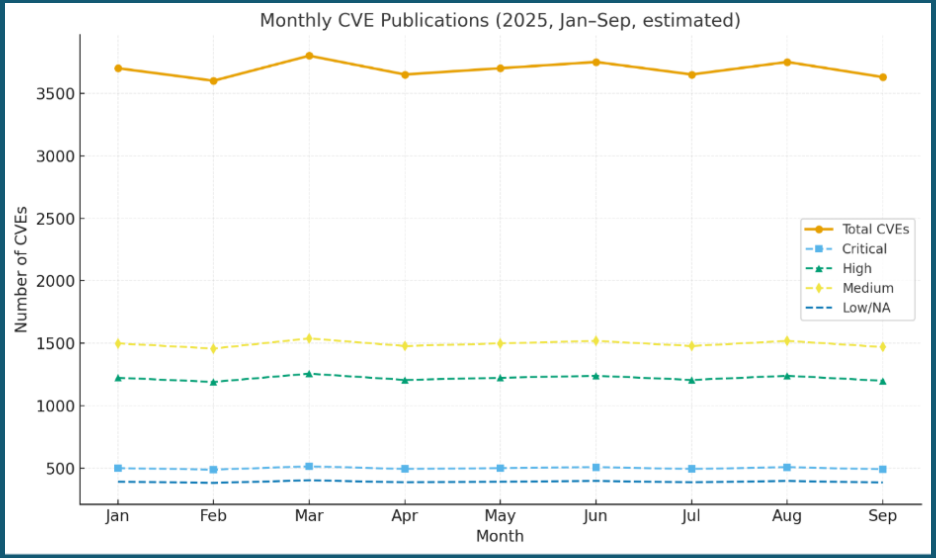
So far in 2025, over 32,000 CVEs have already been logged, and the numbers keep climbing. Each increase creates more opportunities for attackers to exploit weaknesses before they’re patched.
Recent SharePoint Vulnerabilities
Case in point, in a recent meeting, a customer noted that there were two new Microsoft SharePoint Server CVEs (CVE-2025-53770 and CVE-2025-53771) that an attacker had already exploited within days of the announcement, impacting over a hundred production systems.
This is just one example that underscores how quickly adversaries act—and how often. Left unpatched, vulnerabilities like these open the door to unauthorized code execution, data theft, ransomware, and possible lateral movement across your entire enterprise networks.
The Challenge with Traditional Response
When an incident strikes, most organizations rely on drastic measures—cutting network access, pulling servers offline, or scrambling to write new firewall rules. While sometimes necessary, these actions are very disruptive, time-consuming, and costly, halting productivity across the business while IT teams investigate and remediate the security incident.
Today’s reality? Vulnerabilities are inevitable, and no team will ever be 100% patch-ready. What matters is being breach ready—stopping attackers from moving laterally once they gain a foothold.
The faster you isolate and contain the threat, the better you protect your critical assets. You don’t just need protection. You need speed, precision, and control—without sacrificing business continuity.
Breach Response with ColorTokens Xshield
That’s where the ColorTokens Xshield Enterprise Microsegmentation Platform™ changes the game. The Xshield platform includes Breach Response Levels (up to three levels) that let your incident response team quickly apply Zero Trust policies to compromised assets. Each of the levels provides escalating containment—similar to DEFCON stages—depending on the scope of the attack.
Once Breach Response Levels are configured, your team can activate the appropriate level, based on the scope of the incident, to contain compromised assets within minutes—without disrupting trusted services. Instead of firefighting, you stay in control, limiting attacker movement and preserving business resilience.
The real power of Breach Response Levels is that the first three of four steps are preconfigured by your security team. When an attack occurs, all that’s left is to activate the appropriate response level for the affected assets.
How It Works: Four Simple Steps
Step 1 – Define Breach Level Names – Xshield comes with three default Breach Response Levels (Yellow, Orange, Red), which you can optionally rename to match your incident response strategy (e.g., DEFCON1–3).
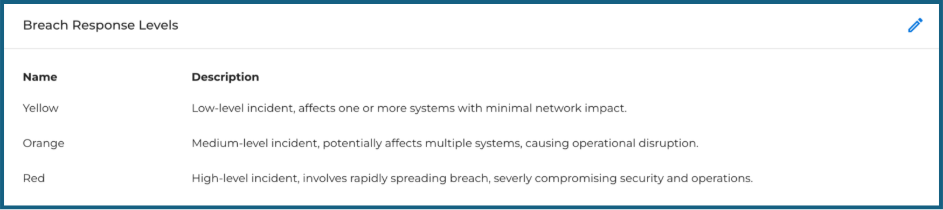
Default Breach Response Levels
Step 2 – Create Breach Response Level Templates – Predefine the Zero Trust security policies that map directly to each of the Breach Response Levels in the event of an attack.
As shown in the example below, the DEFCON1 Breach Response Level Template (Red) has been defined to allow only inbound connections from the company’s internal IT-Jumpservers for TCP ports 22 and 3389.
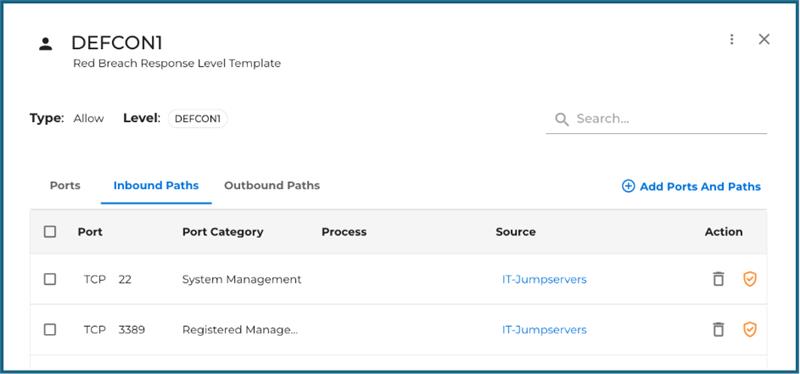
Breach Response Level – DEFCON1 Security Rules Example
For additional Breach Response Level example use cases, see the chart below.
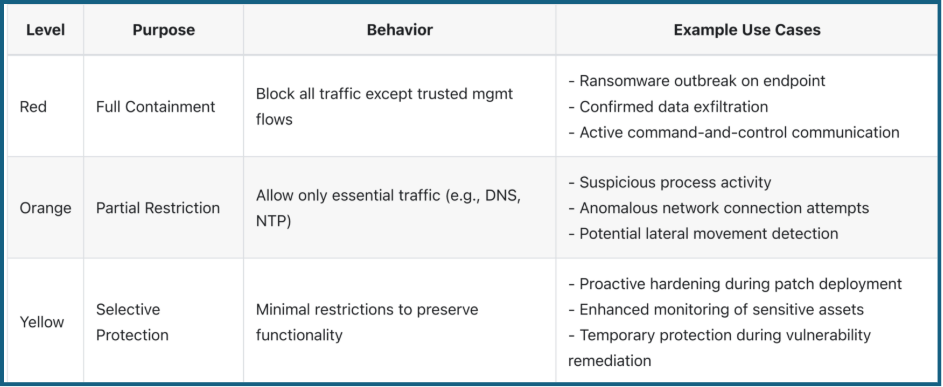
Breach Response Level Use Cases
Step 3 – Assign Breach Response Level Templates to Assets – Once the Breach Response Level templates have been defined, the next step is to preassign the templates to your corporate assets.
In the example below, I have assigned DEFCON1 (Red), DEFCON2 (Orange), and DEFCON3 (Yellow) for one such asset.
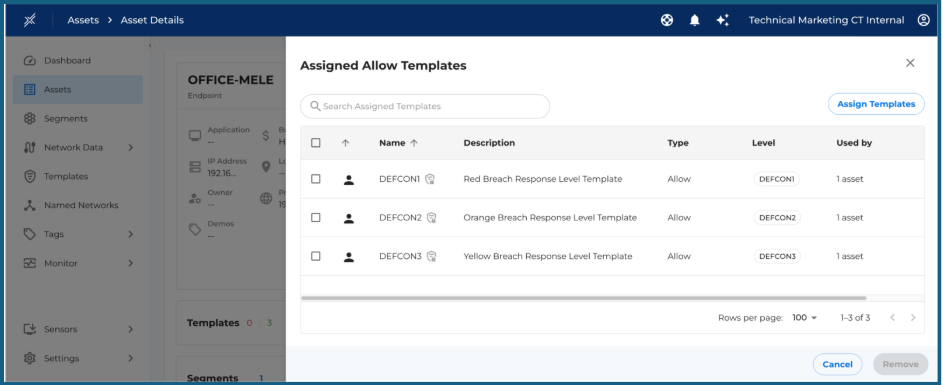
Breach Response Level Template assigned to the asset
Step 4 – One-Click Activation – When an incident occurs, your team simply activates the appropriate Breach Response Level, which has already been predefined, based on the severity of the attack. In minutes, vulnerable systems are quarantined, lateral movement is blocked, and investigations can proceed—without business-wide disruption.
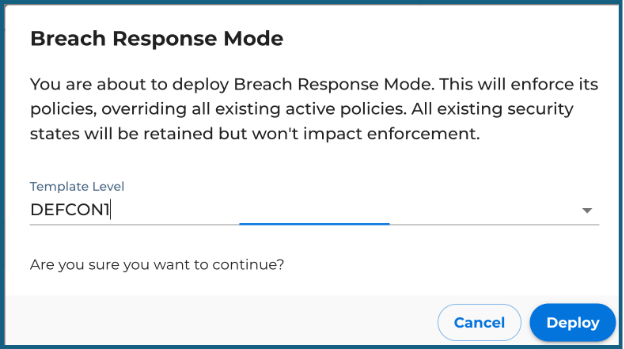
Breach Response Mode Deployment
Once remediation is complete, your team can simply deactivate and restore systems to their normal security posture, ensuring fast recovery and minimal downtime.
Business Value of Breach Readiness
With Xshield’s Breach Response, you can:
- Contain incidents instantly – Stop attackers before they spread across your network.
- Reduce downtime – Protect business operations while security teams investigate.
- Strengthen resilience – Prebuilt templates ensure a consistent, predictable response every time.
- Simplify recovery – Automated restoration gets systems back online quickly and safely.
In today’s world, breaches are not a matter of if, but when. The difference lies in how quickly and effectively you can respond.
A Final Word
With ColorTokens Xshield, organizations can enforce pre-built Breach Response Level security templates, contain threats faster, and maintain business continuity with minimal disruption.
In today’s threat landscape, being breach ready is no longer optional—it’s essential.
Our expert solutions teams are ready to discuss how we can help your organization be breach ready. Schedule a meeting with one of our top advisors.