





In cybersecurity, the odds are stacked against defenders: the attacker only needs to be right once, while the defender must be right every time. A single phishing click or social engineering success can give an adversary a foothold inside your environment.
That’s where microsegmentation proves invaluable. By limiting how systems communicate inside the network, it stops attackers from moving laterally once they’re in. Think of it as securing the corridors inside your castle, so even if someone breaches the wall, they can’t wander freely toward the treasure room.
Yet even this powerful defense, if not implemented correctly, can leave gaps in your security posture. Many microsegmentation implementations focus solely on securing the data center servers or user workstations, leaving dangerous gaps in the cyber defense strategy. Or, they may try using multiple solutions to protect additional asset types, such as Cloud workloads, Kubernetes containers, Operational Technology (OT) devices and Internet of Things (IoT). The result is network security that is fragmented across different enforcement points and management consoles, making it hard for security teams to maintain a unified view or consistent policy – leading to blind spots and inconsistencies that adversaries can exploit.
Are You Breach Ready? Uncover hidden lateral attack risks in just 5 days. Get a free Breach Readiness and Impact Assessment with a visual roadmap of what to fix first.
Fragmented Enforcement: The Blind Spot in Microsegmentation
In many implementations, segmentation lives across multiple enforcement planes: host controls (e.g., OS-level policies), network/SDN overlays, Kubernetes/service-to-service policy, cloud-native controls, and gateway-style controls for unmanaged or legacy/OT devices.
Each uses a different policy model, syntax, and administration console.
This fragmentation creates exactly the problems segmentation was meant to solve:
- Inconsistent intent when the same rule is expressed differently across tools
- Policy drift and human error from parallel change workflows
- Visibility gaps where cross-domain paths go unevaluated
That’s where the pervasive microsegmentation of ColorTokens’ Xshield Enterprise Microsegmentation PlatformTM changes the equation.
Instead of managing segmentation separately in each environment, it delivers a unified administrator experience across all asset types, from data center servers and user endpoints to cloud workloads, containers, IoT, and OT systems.
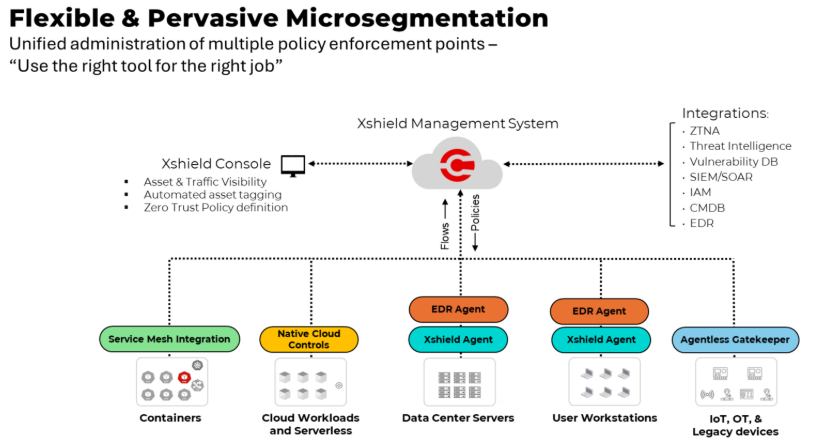
With a single policy model and console, pervasive microsegmentation simplifies operations, reduces errors, and ensures consistent enforcement everywhere. It follows the flexible “right tool for the right job” approach, combining agent-based, agentless, and cloud native controls, while keeping the entire security fabric visible and connected.
The result: fewer weak spots, lower operational overhead, and a continuous defense that leaves no corridor open for attackers to move laterally.
Building the Whole Fence, Not Just the Gates
Too often, organizations focus on locking the “gates” of their network, deploying strong controls around specific systems, while leaving weak links between them. But a locked gate is meaningless if the fence around it is incomplete. Attackers don’t break through what’s hard; they walk around what’s unprotected.
That’s why segmentation must be pervasive.
As IT, IoT, and OT environments converge across hybrid data centers, cloud workloads, and edge devices, security can’t rely on a patchwork of tools. It demands a single, consistent view of policy and enforcement across every asset type.
Pervasive microsegmentation delivers exactly that. By unifying visibility and control, it transforms segmentation from a collection of isolated configurations into a coherent defense fabric, one that closes every path attacker might use to move laterally.
When the entire fence is connected, the breach stops where it starts.
See how pervasive microsegmentation can close your security gaps. Request a demo or start a
no-obligation consultation with our security advisors today.